

Background
The standard advice for composting is to restrict yourself to garden prunings and vegetable peelings, avoid cooked food and, especially, meat and dairy. Since meat, dairy and any cooked foods compost – ie break down – really well and quickly, the reason for this advice is largely to reduce the bin’s attractiveness to rats.
Solutions: Retro-fit Steel Collars and New Slatted Bins
We have successfully trialled two rat-proof composting approaches so that a wider range of materials can be home composted.
The first is a retro-fit steel collar which goes around the base of a standard ‘Dalek’ style compost bin.
The second is a completely new slatted bin made of tough uPVC, sadly no longer available.
In each case, the bin must be placed on hard standing (concrete, slabs, bricks, blocks, paviours or Tarmac) to prevent burrowing by rats. Placing the bin on firm, stable and contiguous hard standing makes absolutely no difference to the composting process; despite what you may have seen on the Internet, read in books or heard on audio. We have empirical proof of this (including photographs) as part of our own initial experimentation and on-going feedback from participants.
We wished to determine if our two designs were truly rat-proof thereby enabling people to comfortably put a wider range of material – ie ALL food waste – into their bins. This would reduce waste that would otherwise go to land-fill or for incineration – both of which are bad destinations – and, as a consequence, waste a useful resource that is free and completely belongs at you!
The designs are the work of an engineer (the practical products) and a biologist (the composting assessment, systematic trails and the on-going installations and work with participants).
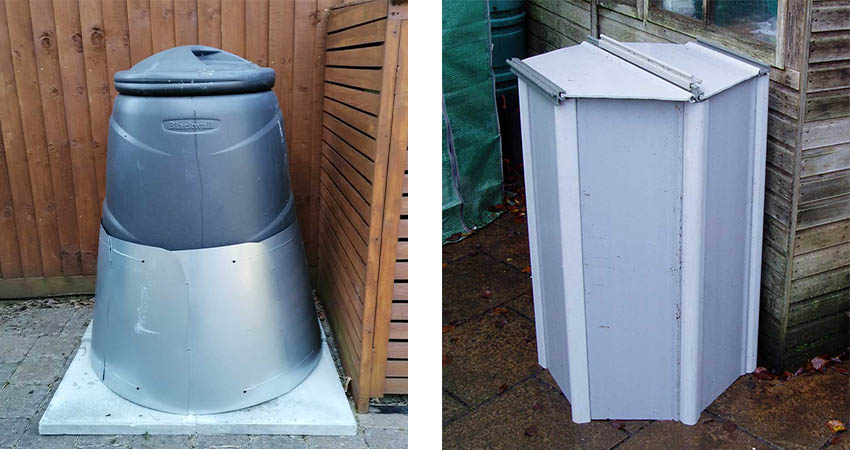
The Results
With over 50 installations – some of which have been in place for over five years – the trials have been a success; none of the bins have been invaded by rats.
The vast majority of installations have been to domestic homes. However, we do have installations in a few schools across Hampshire and Southampton. These are also successful.
Cost
Steel Collars:
The steel collars are manufactured by a commercial company. Stock is purchased from this company and subsequently supplied – at cost – to project participants via Transition. We currently have stock. Prices, based on existing supplier purchases, are £49 for each collar.
Slatted Bins:
We currently have no stock. Unfortunately the manufacturer – which may be the only organisation making the flat piling that we used for the bin’s construction – has ceased manufacture of that component. We continue to explore other, broadly similar, designs and look for similar materials from other suppliers. There is currently no ETA.
How to Participate
The project is way beyond trial mode. We have proven solutions if you have an existing rat problem. Similarly, if you wish to start to compost a broader range of materials without subsequently suffering from rats, our solutions will support that change.
We have found that it is best if we make a quick site visit – if possible – before any purchase and installation. However, we now have installations in Yorkshire, East Sussex, Essex, Somerset, London, Oxfordshire and elsewhere where no site visits were made beforehand; all these installations (like the others) have been a success.
Rat-proof collar delivery, beyond reasonable travelling distances, is made by courier at the recipient’s expense. We can discuss delivery costs as appropriate.
If you’re interested in taking part by purchasing a collar, let us know!
We would love to have another group collaborate on this project to spread the concept more widely. This not a commercial venture – it is a not for profit initiative – we just want to see it happen! Please contact us if you are interested. More volume might bring the price down, bringing the collars within reach of a wider group of people.
Contact us using this form if you are interested in participating in any way.
Thank you.
PS If you have requested information about this project, and haven’t received a reply, please look in your SPAM folder, just in case your email system has put our email there. It has happened before, frequently. Thanks.